Best Nonprofit CRM Software in 2026
If you've started Googling "best nonprofit CRM," you've probably noticed the same five or six names keep showing up in a different order every time. That's because there isn't one right answer — there's a right answer for your organization's size, budget, and specific needs.
This guide breaks down the top nonprofit CRM options in 2026, what actually makes a CRM good for a nonprofit, and where an all-in-one platform like MonkeyPod fits in.

What to look for in a nonprofit CRM
A generic sales CRM tracks leads and deals. A nonprofit CRM needs to do more: it has to understand donors, memberships, volunteers, and grants as relationships, not transactions to close.
When you're evaluating options, look for:
- Donor and constituent history in one timeline — every gift, email, event RSVP, and interaction tied to a single contact record, not scattered across multiple tools
- Segmentation that goes beyond "donor" and "non-donor" — the ability to find lapsed donors, first-time givers, and monthly sustainers without exporting to a spreadsheet or cross-checking against several platforms
- Built-in stewardship automation — automatic thank-you emails, receipts, and follow-up reminders so gratitude doesn't depend on someone's memory
- Transparent, predictable pricing — number of contacts, users, and email sends included in the cost. Many nonprofit CRMs price by contact or record count, which means your software bill grows every time your database does
- Real support from people who understand nonprofits — not just a chatbot or a generic ticketing queue
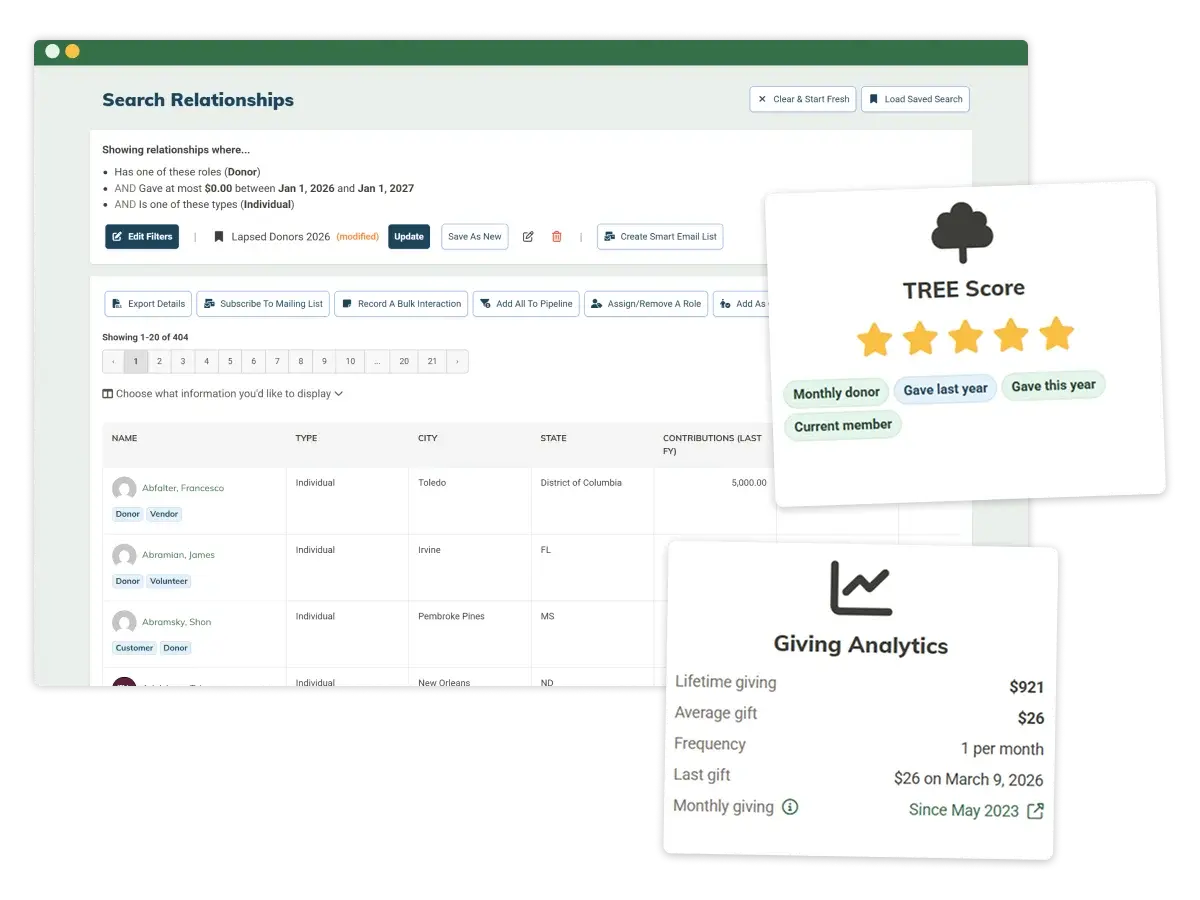
The harder question — the one that actually determines your total workload — is what happens outside the CRM. Does donor data need to be re-entered into your accounting software? Does someone have to reconcile the CRM's numbers against QuickBooks every month? That gap is where a lot of administrative hours quietly disappear.
Top nonprofit CRM options compared
Here's how the most commonly recommended nonprofit CRMs stack up on the things that matter most: pricing, what's actually included, and who each one is really built for.
| Feature | Bloomerang | Neon CRM | DonorPerfect | Little Green Light | Givebutter | MonkeyPod |
|---|---|---|---|---|---|---|
| Starting price | $125/mo (CRM only, annual) | $99/mo | Approx. $99/mo | $45/mo | Free; Plus from $29/mo | $167/mo (billed annually) |
| Pricing model | Per contact | Per revenue | Per record | Per record | Free w/ tips; Plus per contact | Flat rate |
| Accounting built in | No | No | No | No | No | Yes — fund accounting |
| Grant proposal tracking | Yes | Yes | Yes | Basic | No | Yes |
| Grant spend tracking | No | No | No | No | No | Yes |
| Email marketing | Basic | Yes | Via integration | Basic | Yes | Yes |
| Best for | Orgs focused specifically on donor retention | Membership-based organizations | Fundraising automation and donor reporting | Small orgs with simple operations | Small orgs focused on donors | Orgs that want CRM, accounting, and grants in one system |
Bloomerang, Neon CRM, Little Green Light, and Givebutter pricing verified against each vendor's public pricing page — see sources below. DonorPerfect does not publish a public rate card; its figure is an estimate.
A few things worth noting from this table:
- Bloomerang's CRM is strong for donor cultivation, but the price grows as your contact count does. It has limitations if you need to track more than just donors and you'll likely still need a separate email tool for anything beyond basic campaigns.
- DonorPerfect is a solid donor-centric CRM, but custom reports may be cumbersome to build, and some users find the interface clunky. You also pay more as your contact count grows, and you'll need a separate email tool.
- Neon CRM includes features that are helpful for organizations with complex membership programs, and their revenue-based pricing is a nice if you don't want to be penalized as you grow.
- Little Green Light is honest about its per-record pricing, but many orgs quickly outgrow the platform.
- Givebutter offers free, no-frills fundraising pages if your donors give them a tip. If you need deeper donor management, you'll need to upgrade to Givebutter Plus, which costs more as you add donors.
- None of these CRMs include built-in fund accounting. Once you raise the money, you need to track it in a separate platform.
Best for small teams with simple operations
If your organization is small, with few staff, and mostly needs to track gifts and send the occasional email, Little Green Light and Givebutter may be sufficient. Little Green Light's pricing is transparent — you know exactly what you'll pay at every record tier, with no per-user fees. Givebutter's free tier asks your donors to leave a tip and offers basic fundraising and CRM needs. Fees kick in once you want its more advanced automation and reporting features through Givebutter Plus.
The catch with both: they're built for organizations with fairly simple needs. Once you're managing restricted grants, running multiple revenue streams (ticket sales, memberships, and donations at once), or need real financial reporting, you'll likely outgrow them. That happens sooner than most people expect.
Best for donor retention and relationship-focused fundraising
If your primary focus is cultivating and retaining donors and relationship management, then donor-centric platforms like Bloomerang and DonorPerfect are decent options. Bloomerang and DonorPerfect's strengths include donor engagement tracking, retention-focused reporting, and tools that can help nonprofits understand donor activity and identify opportunities for follow-up.
For organizations that want a straightforward system that encourages staff to consistently engage with donors, Bloomerang can be appealing. Though organizations with more complex fundraising operations or extensive customization needs may find it less flexible than a more robust, customizable CRM.
DonorPerfect is generally more flexible and customizable, particularly around its fundraising features, which could be useful for nonprofits with established processes or that need their database to support a variety of fundraising programs. However, its user interface isn't as intuitive and some find the customizations require a steep learning curve. Email marketing is not built into DonorPerfect, so you will need a separate email platform. Organizations looking for a very simple, immediately intuitive system may find DonorPerfect requires more setup, training, and ongoing database management.
Best overall CRM for nonprofits
This is where most nonprofit CRM comparisons stop short, because most CRMs — including Bloomerang, Neon CRM, DonorPerfect, Little Green Light, and Givebutter — are exactly that: CRMs. They track your donors, but they don't track your money. (For a broader feature-and-pricing rundown of individual platforms, see our roundup of the top 10 nonprofit CRM platforms for 2026.)
That means your bookkeeper is working in QuickBooks or Aplos while your development team works in the CRM, and someone else is reconciling the two every month. Even with a CRM-to-QuickBooks integration in place, you're still running two separate systems. Syncing isn't the same as having a single source of truth.
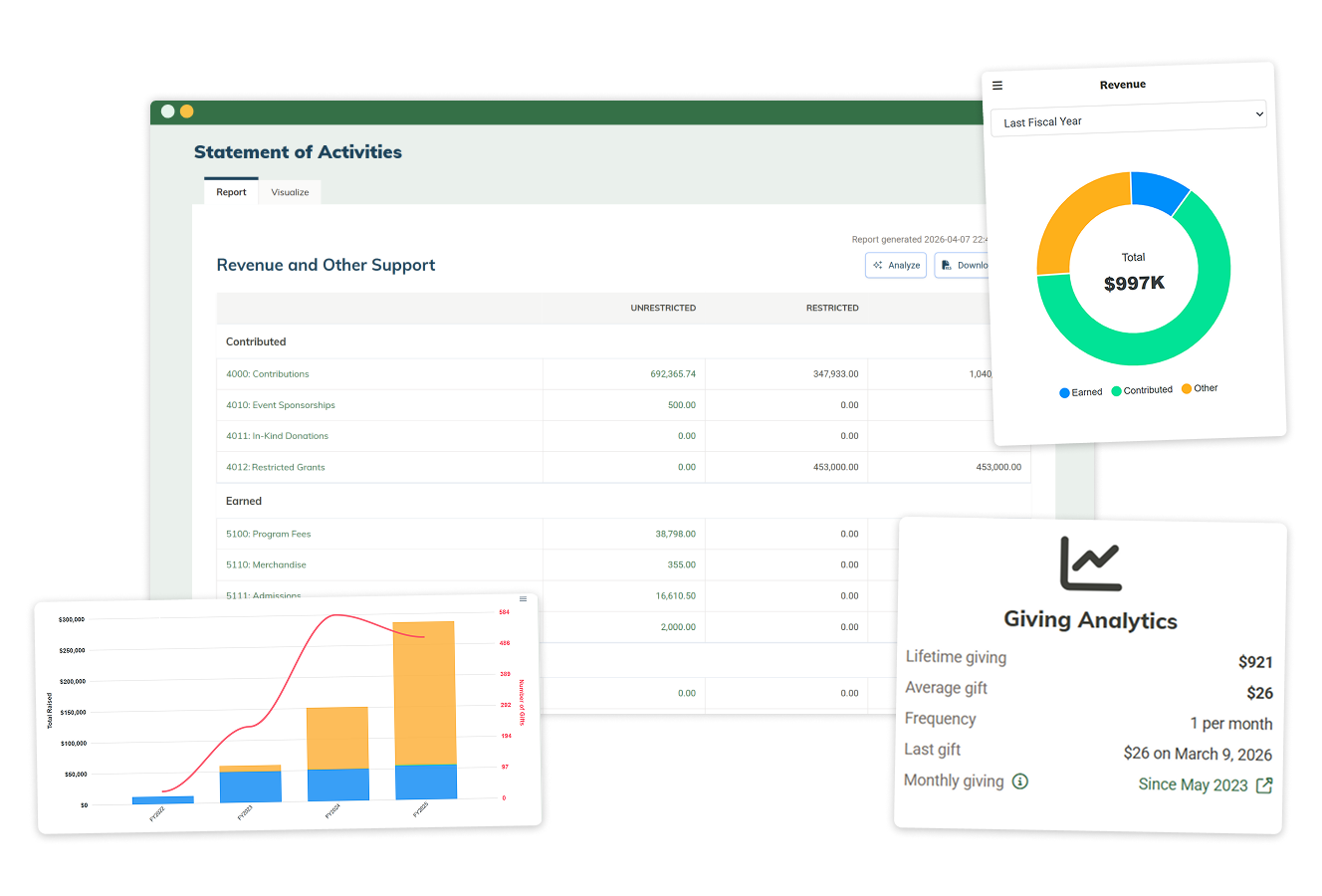
With MonkeyPod, donor management and nonprofit fund accounting live in the same platform. When a gift comes in, it automatically becomes a CRM record and an accounting entry — no export, no import, no double data entry. In the same system, you can track restricted grant income. Grant budgets sync to actuals in real time, so a program director can check "how much of this grant have we spent" without waiting on the finance team to run a report.
That's the practical answer to why integrated accounting and CRM systems reduce administrative overhead: every hour spent reconciling two disconnected systems is an hour not spent on your mission. When the CRM and the books are the same system, there's nothing to reconcile.
Every MonkeyPod plan includes CRM and accounting functionality. You can track grant expenses, manage donors, and monitor budgets in the same place. For a closer look at how the accounting side stacks up against QuickBooks and Aplos, see our nonprofit accounting software comparison. MonkeyPod's pricing starts at $167/month billed annually, and every plan includes unlimited users and unlimited data.
Which nonprofit CRM should you choose?
If your organization is happy running a CRM and an accounting system separately, then Bloomerang, Neon CRM, DonorPerfect, Little Green Light, or Givebutter are reasonable tools to use. Here's who each tool is best for.
- Bloomerang is best for donor retention and relationship-focused fundraising.
- Neon CRM is best for organizations that aren't looking to increase their revenue. Pricing tiers scale up as your total revenue grows, so if you don't anticpate growth, it can be a good option.
- DonorPerfect is best for nonprofits that want a highly customizable, fundraising-centered CRM and are willing to invest time in configuring it to their processes.
- Little Green Light is best for small nonprofits that want a low-cost, no-frills donor database without built-in accounting.
- Givebutter is best for nonprofits doing a lot of campaign-based, event-based, peer-to-peer, or online fundraising.
But if you're tired of that reconciliation work, or you're setting up systems for the first time and would rather not build a patchwork of tools you'll have to untangle later, MonkeyPod is worth a look. MonkeyPod is the best CRM for nonprofits that need an all-in-one platform combining donor management and accounting. It's built for organizations with small teams and multiple revenue streams and reduces administrative overhead for nonprofits.
Frequently asked questions
Last updated: September 18, 2026
-
There's no single "best" — it depends on what else you need the system to do. For donor cultivation specifically, Bloomerang is a strong, well-established choice. If you also want your accounting, grant tracking, and email marketing in the same system as your donor data, MonkeyPod is built for that. The right choice comes down to whether you want a CRM alone or a CRM connected to everything else your organization runs on.
-
Little Green Light and Givebutter are both known for fast, low-friction setup — useful if you're starting from scratch or migrating off spreadsheets. MonkeyPod includes a dedicated implementation expert and orientation with every plan, plus guided data import support, so setup doesn't fall entirely on your team even though the platform covers more ground.
-
Little Green Light (starting at $45/month) and Givebutter's free tier are the most budget-friendly starting points for very simple needs. If your small team also needs accounting and grant tracking built in, MonkeyPod's flat $167/month (billed annually) replaces several separate subscriptions (CRM, accounting software, email tool), which often works out cheaper than paying for each one individually.
-
Little Green Light is designed around simplicity — one plan, transparent per-record pricing, no add-on upsells. Bloomerang and Neon CRM are also donor-management-first tools with strong reputations. MonkeyPod's CRM is comparable for donor tracking, segmentation, and stewardship automation, and it includes accounting, grant management, and more, so nonprofits only have one subscription to manage.
-
Integrated CRM and accounting systems cut administrative overhead by eliminating double data entry. With separate systems, each donation needs to be entered twice — once in the CRM to track the relationship and once in the accounting system to track the income. MonkeyPod is a nonprofit CRM with built-in fund accounting, so the relationship and financial information are recorded once, automatically, in the same database.
-
Yes. MonkeyPod includes nonprofit fund accounting (restricted and unrestricted fund tracking, budgets, standard nonprofit financial statements) alongside full donor and constituent management, so organizations typically use it in place of running QuickBooks and a separate CRM side by side.
See your donors and your books in one place
We'd love to show you around. Schedule a demo to see how MonkeyPod handles your donor relationships and your books, together in one place.
Transforming communities everywhere